Layered Defence: Moving Beyond High Walls and Electric Fences
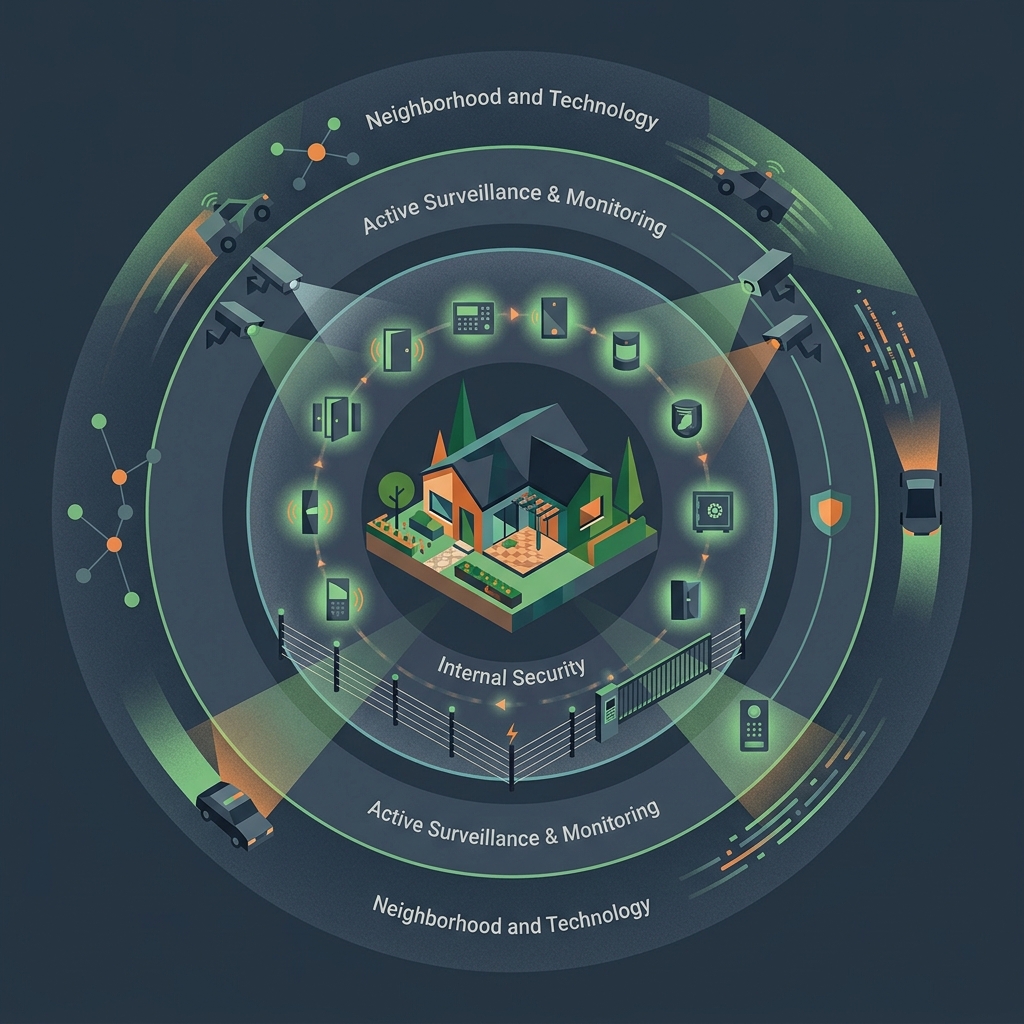
South Africa has the highest walls in the world. We have electric fences, razor wire, armed response, palisade fencing, security gates on every internal door, and panic buttons on our bedside tables. And yet residential crime — burglary, home invasion, robbery — remains a persistent, daily reality.
The question is not "are we spending enough on security?" South African households spend more on private security per capita than almost any other country. The question is: are we spending it on the right things?
This guide challenges the "fortress mentality" and introduces the concept of layered defence — a systematic approach drawn from OHS site management and law enforcement, where security is built in rings rather than a single barrier.
Why the Fortress Fails
The typical South African security setup is what professionals call "perimeter-dependent." Everything relies on the boundary wall or fence. If that perimeter is breached — and it always can be — there is often very little between the criminal and your family.
The Problems with Perimeter-Only Thinking
- Walls create blind spots. A 2.4-metre wall with electric fence gives you privacy, but it also hides the criminal once they're on your property. You can't see the threat approaching, and your neighbours can't see the threat on your property.
- Electric fences are defeatable. A rubber mat, a pair of insulated wire cutters, or simply cutting the power supply during load shedding. Electric fencing is a deterrent, not a barrier. Criminals who have decided to target your property have already accepted the fence.
- Alarm fatigue. Your armed response company receives hundreds of false alarms daily. Response times vary. When every alarm is treated as "probably the wind," the system loses its edge.
- Single point of failure. If your only strategy is "wall + alarm + response," then a breach at any one point collapses the entire system. This is the opposite of resilient design.
The Five Layers of Residential Defence
Layered defence is borrowed from military doctrine and site security management. The principle is simple: create multiple rings of security, each one independent of the others. A failure at any single layer is contained because the next layer remains intact.
Layer 1: Community & Street (Outermost)
Your first line of defence is not your wall — it's your street. Security starts at the neighbourhood level:
- Active neighbourhood watch or WhatsApp security group. Not for sharing rumours — for coordinated, real-time reporting of suspicious activity to your local security provider or CPF (Community Policing Forum).
- Street-level CCTV. Many suburbs now pool resources for shared camera systems at entry/exit points. If your street doesn't have this, raise it at the next neighbourhood meeting.
- Know your neighbours. The most effective security system in any South African suburb is neighbours who know each other, communicate, and watch for anomalies. A stranger at number 14 is only suspicious if you know what "normal" looks like at number 14.
- Report every incident. Even "minor" crimes — attempted break-ins, suspicious vehicles, trespassing — should be reported to SAPS. This builds the crime data that determines police patrol allocation in your area. Unreported crime means fewer patrols.
Layer 2: Property Perimeter (Your Boundary)
Your wall and fence remain important — but as a deterrent, not as your primary defence:
- Visibility over height. Counter-intuitively, a 1.8m palisade fence that allows visibility is often more effective than a 2.4m solid wall. Why? Because the criminal cannot hide once they enter your property, and neighbours and passers-by can see in. Criminals fear witnesses more than walls.
- Anti-climb measures: Rotating spikes, "cat's claw" strips, and anti-grip coatings are more effective than simply adding height. They make the physical act of climbing uncomfortable and time-consuming.
- Perimeter lighting: Darkness is a criminal's greatest tool. Motion-activated LED floodlights along the perimeter — especially near gates and potential entry points — are one of the cheapest and most effective deterrents available. Ensure they are positioned to eliminate shadows along walls. Consider solar-powered units that work during load shedding.
- Gate protocol: Your gate is your single biggest vulnerability. Never open it remotely without visual confirmation of who is outside. If you have an intercom without a camera, install a camera. If you have a camera but don't check it, develop the habit.
Layer 3: Property Grounds (Between Fence and House)
This is the layer most South African homes completely ignore. The space between your boundary and your front door should not be a free passage:
- Motion-activated lights and alerts on all approaches to the house — front, sides, and back. Not just at the front door.
- Gravel paths. It sounds low-tech, but gravel is noisy. A criminal approaching your house across gravel at 2am cannot do so silently. It's a cheap, maintenance-free alarm.
- Eliminate hiding spots: Trim dense bushes near windows and doors. Remove anything that provides concealment near entry points. Apply the "can I see from here to there?" test from every window in your house.
- CCTV with recording. Cameras are only useful if they record, if the recording is stored off-site (so a criminal can't steal the DVR), and if you actually review footage when alerts are triggered. Cloud-based systems solve the storage problem.
Layer 4: The House Itself (Physical Structure)
- Security gates on all external doors. This is standard in SA, but the quality matters. A R800 gate from a hardware store is not the same as a professionally installed, SABS-compliant slam-lock gate. The gate should buy you time, not give you a false sense of security.
- Window burglar bars or security film. Bars remain effective. If aesthetics are a concern, security window film prevents glass from shattering inward and slows entry significantly.
- The "safe room" concept: Identify one room in the house — typically the main bedroom — that can be secured as a final refuge. Solid door, deadbolt, charged phone, panic button, and your armed response's direct contact number. In a home invasion, getting your family into this room and locking it is the priority.
- Alarm zones: Your alarm should be zoned so that you know which zone was triggered, not just "alarm active." This tells your response company where to focus when they arrive.
Layer 5: Personal Readiness (Innermost)
- Family emergency plan. Every family member should know: where the safe room is, how to activate the panic button, what the armed response company's number is, and what to do if they are alone when the alarm triggers.
- Panic buttons. Not just one — one per adult, plus one in a central location (kitchen). Modern systems allow wearable panic buttons that work anywhere on the property.
- Communication chain: Know your armed response company's expected response time. Have backup — a neighbour's number, the local SAPS station's direct line (not 10111 — the station itself).
- Load shedding protocol: During load shedding, many alarm systems run on backup batteries with limited life. Know how long your system lasts on battery. If it's less than the scheduled outage, you are unprotected. Invest in a longer-life backup battery or UPS.
Load shedding is a security event, not just an inconvenience. When power drops: electric fences go offline, gate motors fail to manual (easier to force), motion sensors may deactivate, and alarm batteries drain. Criminals know this. Stage 4 and above is when residential crime spikes. Your security system must be designed for the assumption that the power will go off.
Psychological Deterrence: The Layer Nobody Talks About
Criminals make risk assessments. Every target is evaluated against the perceived difficulty, the perceived reward, and the perceived chance of getting caught. Psychological deterrence manipulates these calculations:
- Visible cameras are better than hidden ones. A hidden camera catches the criminal on footage. A visible camera prevents the crime from happening. For residential security, prevention beats prosecution every time.
- "Beware of dog" signs work — even without a dog. Dogs are one of the most effective deterrents in South Africa because they are unpredictable and noisy. A sign suggesting a dog increases perceived risk.
- Signs of occupancy: Timers on lights and radios when you're away. Don't let mail accumulate. Ask a neighbour to park in your driveway if you're on holiday. An empty-looking house is an invitation.
- Unpredictability: If your garden service comes every Wednesday at 10am, and your cleaner comes every Thursday at 8am, and you leave for work at 7:15am every weekday — you are predictable. Vary at least one element of your home routine weekly.
The goal is not to build an impenetrable fortress. The goal is to make your property look harder, riskier, and less rewarding than the next one on the street. Criminals take the path of least resistance. Ensure that path doesn't lead through your property.
Need a Professional Security Assessment?
27 years of OHS site management experience applied to your home or business. Layered defence design, risk assessment, and compliance — from someone who has managed the real thing.
Request Legacy Risk Consultation →